
TecQuipment's Frame Deflections and Reactions (Next Generation Structures) experiment is for the study of rectangular portals subjected to vertical loads. It mounts on the Structures platform and connects to Structures automatic data acquisition unit and software.
Quanser's Mobile Robotics Engineering Lab Equipment encompasses an array of cutting-edge tools designed to elevate the educational experience in robotics engineering. From the innovative Quanser QBot 3, an open-architecture autonomous ground robot built on a 2-wheel mobile platform, to a comprehensive suite of sensors, vision systems, and adaptable courseware, this collection offers a dynamic platform for both undergraduate and advanced studies in robotics and mechatronics.
Professors benefit from the modular nature of the laboratory exercises, enabling seamless integration into existing courses or creating new curricula. Additionally, the platform's versatility extends beyond academia, providing a robust foundation for research in fields such as autonomous vehicle control, machine learning, computer vision, and multi-agent heterogeneous and swarm robotics. Quanser's Mobile Robotics Engineering Lab Equipment empowers students and researchers alike to explore, innovate, and excel in the dynamic realm of robotics.
Quanser’s expansive range of engineering teaching equipment offers the fastest and easiest way to meet academic objectives for teaching and research.
Credible, interactive virtual hardware experiences
The only scalable way to deliver meaningful, high-fidelity virtual hardware experiences to students via desktop or smart devices.
The Quanser Interactive Labs platform is a collection of virtual hardware-based laboratory activities that supplement traditional or online courses. The virtual plants are based on Quanser physical systems and offer credible, academically appropriate hardware experiences on desktops, laptops, or smart devices. Combining Quanser Interactive Labs with actual Quanser systems allows instructors to enrich their lectures and activities in traditional labs and increases engagement and students’ learning outcomes in class-based or online courses.
Rich interactive experiences for the lecture and the lab
Leverage Quanser Interactive Labs not only to offer students credible lab activities accessible off-campus but integrate them into your lectures and bring even more interaction and engagement to your course material.
A turn-key cross-platform solution
Quanser Interactive Labs’ virtual high-fidelity plants give students academically appropriate hardware experiences on Windows, macOS, iOS, and Android. Labs come with a complete student curriculum, including “check your understanding” and full assessment questions and lab reporting. Instructors have access to additional free course resources and tools to manage student access and monitor their progress.
Scalable solutions for teaching and research
Quanser Interactive Labs are stand-alone applications available as a 12-month subscription and can be licensed by institutions for their students or purchased directly by students.
Pages
-
 Item Number:STS18 - Experiment
 -
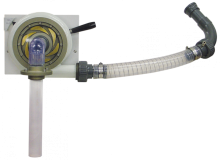 Item Number:MFP101D - Experiment
The Francis Turbine is a reaction turbine. It is the most common turbine in the world, due to its ability to work for a wide range of applications. Its moving part (runner) is a radial impeller.
-
 Item Number:H18 - Experiment
The Francis Turbine is a laboratory-scale reaction turbine for use with TecQuipment’s Digital Hydraulic Bench (H1F, available separately<
-
 Item Number:TD1005 - Experiment
Benchtop apparatus that illustrates free and forced convection from different transfer surfaces.
-
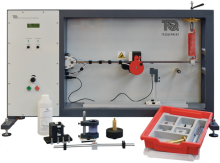 Item Number:TM1016V
Benchtop apparatus that investigates the free and forced vibrations of a rigid beam with a spring, and a simply supported beam. Demonstrates Rayleigh's approximation and Dunkerley's method.
-
 Item Number:TM165
An experiment that demonstrates the oscillatory motion of a disc attached to a slender rod. Fits on to the Free Vibrations Test Frame.
-
 Item Number:TM167
An experiment that demonstrates the oscillatory motion of a rigid beam, pivoted at one end and suspended by a spring at the other. Fits on to the Free Vibrations Test Frame.
-
 Item Number:TM164
Experiment that uses simple harmonic motion theory to demonstrate how to calculate the frequency of oscillation of simple mass-spring systems; demonstrates Hooke's law. Fits on to the Free Vibrations Test Frame.
-
 Item Number:TM166
An experiment that uses the fundamental theory and Rayleigh's approximation to calculate the frequency of oscillation of a cantilever. It also utilizes Dunkerley's method to predict the 'beam only' frequency. Fits on to the Free Vibrations Test Frame.
-
 Item Number:TM160 - Base Unit
A sturdy bench top frame for use with the Free Vibrations experiment modules.