
Nozzle and pipe flow kit, for fitting to the MFP106 fan test set.
Quanser's Mobile Robotics Engineering Lab Equipment encompasses an array of cutting-edge tools designed to elevate the educational experience in robotics engineering. From the innovative Quanser QBot 3, an open-architecture autonomous ground robot built on a 2-wheel mobile platform, to a comprehensive suite of sensors, vision systems, and adaptable courseware, this collection offers a dynamic platform for both undergraduate and advanced studies in robotics and mechatronics.
Professors benefit from the modular nature of the laboratory exercises, enabling seamless integration into existing courses or creating new curricula. Additionally, the platform's versatility extends beyond academia, providing a robust foundation for research in fields such as autonomous vehicle control, machine learning, computer vision, and multi-agent heterogeneous and swarm robotics. Quanser's Mobile Robotics Engineering Lab Equipment empowers students and researchers alike to explore, innovate, and excel in the dynamic realm of robotics.
Quanser’s expansive range of engineering teaching equipment offers the fastest and easiest way to meet academic objectives for teaching and research.
Credible, interactive virtual hardware experiences
The only scalable way to deliver meaningful, high-fidelity virtual hardware experiences to students via desktop or smart devices.
The Quanser Interactive Labs platform is a collection of virtual hardware-based laboratory activities that supplement traditional or online courses. The virtual plants are based on Quanser physical systems and offer credible, academically appropriate hardware experiences on desktops, laptops, or smart devices. Combining Quanser Interactive Labs with actual Quanser systems allows instructors to enrich their lectures and activities in traditional labs and increases engagement and students’ learning outcomes in class-based or online courses.
Rich interactive experiences for the lecture and the lab
Leverage Quanser Interactive Labs not only to offer students credible lab activities accessible off-campus but integrate them into your lectures and bring even more interaction and engagement to your course material.
A turn-key cross-platform solution
Quanser Interactive Labs’ virtual high-fidelity plants give students academically appropriate hardware experiences on Windows, macOS, iOS, and Android. Labs come with a complete student curriculum, including “check your understanding” and full assessment questions and lab reporting. Instructors have access to additional free course resources and tools to manage student access and monitor their progress.
Scalable solutions for teaching and research
Quanser Interactive Labs are stand-alone applications available as a 12-month subscription and can be licensed by institutions for their students or purchased directly by students.
Pages
-
 Item Number:MFP106A - Experiment
 -
 Item Number:H405 - Experiment
A self-contained unit for teaching the principles of pipe surge and water hammer.
-
 Item Number:H34 - Experiment
A simple single pipeline apparatus to demonstrate energy losses around typical bends and fittings.
-
 Item Number:MFP103A - Experiment
A piston pump for use with the MFP103 Positive Displacement Pump Support Module.
-
 Item Number:STS15 - Experiment
TecQuipment's Plastic Bending of Beams (Next Generation Structures) is an experiment to study plastic theory and limit state design of beams. Mounts on the Structures platform and connects to the Structures automatic data acquisition unit and software.
-
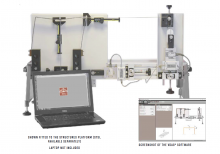 Item Number:STS16 - Experiment
TecQuipment's Plastic Bending of Portals (Next Generation Structures) is an experiment for the study of plastic theory and limit state design in portal frames. Mounts on the Structures platform and connects to the Structures automatic data acquisition unit and software.
-
 Item Number:CE111 - Experiment
Provides a physical system on which students can gain experience in the programming of programmable logic controllers (PLCs). The process is a model of a two-tank system typical of a chemical process in which liquids are measured before being mixed. The task for the student is to control liquid level and flow. For use with the PLC Trainer (CE123).
-
 Item Number:CE123 - Base Unit
Uses an industry standard PLC to control the PLC Process using ladder logic programming running on a PC. For use with the PLC Process (CE111).
-
 Item Number:AU9077
This kit can be added to the Automatics essentials solution to produce learning outcomes for those wishing to study about rugged, industrial PLCs. By following the provided curriculum, students will l ...
-
 Item Number:PSA55 - Ancillary
A portable capacitive load bank comprising 12 individual switched load capacitances arranged in three banks of four for Star or Delta connection.