An apparatus to allow students to investigate the forces produced by a water jet striking a flat or a curved surface.
The global standard in transformational engineering labs for Controls, Robotics, and Mechatronics, optimized for the academic setting.
Academic institutions trust Quanser to strengthen their reputation through transformative teaching and research labs that accurately replicate theories and bring engineering mathematics and concepts to life.
“We are in a golden age of engineering education. There’s a lot to be excited about and a lot to be challenged by. The education we offer students must capture this momentum and help them realize their potential.”
– Paul Gilbert, CEO, Quanser
The standard in controls teaching and research.
Modeling & controls lie at the core of emerging technological breakthroughs. From drones to reusable rockets to self-driving vehicles, the fundamentals of modeling & control are a critical skill for engineers to compete and innovate.
Process Control
The modern industrial systems that are fundamental to modern automation and manufacturing processes require specialized control systems to perform and manage their daily operations. Quanser offers a variety of plants that can be used to teach the key elements of modern process control including cascade control with the Maglev and Ball and Beam systems as well as regulator design with the Coupled Tanks.
Classic Systems Control
The classic progression of control systems education begins with the fundamentals of modeling and designing control plants for linear systems. Quanser offers a diverse collection of plants that can be used as ideal platforms to offer students experience using classic control principles. These plants offer basic dynamics that range from rotary to linear motion.
Modern Systems Control
Quanser has a collection of plants that can be used to show how a modern approach to control systems allows for the creation of precise controllers for complex systems with higher-order dynamics. These plants include both dynamically complex plants such as the linear inverted pendulum, and double pendulum, as well as plants such as the active suspension that require the use of both state-space modeling to express the complex coupled dynamics of the system.
Unstable Systems
Some of the most exciting emerging technologies from bipedal walking robots to reusable rockets requires the design of controllers for unstable systems. Quanser offers several plants that give students an experience creating control systems for directly analogous dynamic systems.
Whether you are researching advanced algorithms or require state of the art technology to teach tomorrow's robotics engineers, Quanser's engineering lab solutions has the perfect option for your needs.
Mobile Robotics
Many consider mobile robotics the most dynamic engineering specialization. Quanser’s ground and aerial solutions offer a combination of advanced hardware with a powerful software framework powered by Quanser’s renowned QUARC® and built on the MATLAB®/Simulink® platform. Quanser solutions feature the latest processors and flexible support of sensors. They may be combined to create a UVS Lab that offers full localization and a comprehensive platform for multi-agent applications.
Manipulator Robotics
The study and exploration of serial link robots has been a core component of robotics education and research. Originally, the study of manipulator robots was driven by applications in manufacturing, but later became an important subsystem in more complex robotic applications in both space robotics and mobile robotics.
Open Architecture Research Robots
Quanser's research solutions allow you to deploy your own advanced control algorithms by providing students and researchers direct access to the robot’s sensors and actuators. With the capabilities of the communication block sets of Quanser’s QUARC software validating your robotic control algorithms is easier than ever.
Telerobotics and Haptics
This solution is the platform of choice for advanced telerobotic applications with haptic feedback. It consists of an advanced robot manipulator equipped with a force/torque sensor mated a high DOF haptic manipulator and Quanser’s QUARC real-time control software. This turn-key solution can be deployed quickly and is readily adaptable for a wide range of force-feedback research applications. Combined with visualization, it is the ideal platform for medical simulations, remote vehicle operations, and more.
Essential sequence for undergrad mechatronics
Quanser offers the only complete Mechatronics lab sequence that covers everything from fundamentals to fully integrated systems.
With Quanser’s mechatronic solutions, instructors can focus on teaching fundamentals of the mechatronics subsystems and advanced applications with fully developed robust hardware powered by rigorous software.
Traditionally, developing a fully functional mechatronic system requires expertise in actuation, sensing, control, and vision, along with time developing hardware and software. This development process, although rigorous, can interfere with understanding fundamentals, and takes away precious time that can be otherwise dedicated to innovation. With Quanser’s mechatronic lab equipment, instructors can focus on teaching fundamentals of the mechatronic subsystems and advanced applications with fully developed robust hardware powered by rigorous software.
Built exclusively for the NI ELVIS platform, the Mechatronics top boards series includes:
- Sensors: survey of common mechatronic sensors used in industry
- Actuators: design considerations, common specifications, interfacing and operation techniques for a variety of actuators
- Systems: a complete mechatronic system designed to explore, develop and integrate component subsystems
Integrated Systems
Quanser has a variety of products for teaching system integration. The Quanser Mechatronic Systems board is the flagship systems trainer with hardware, software, and courseware developed specifically to teach mechatronic systems integration. From actuators and FPGA sensor integration, through mathematical modeling and image processing, to state machines and advanced applications, the Quanser Mechatronic Systems board offers a rich experience for students.
The QUBE-Servo 2 and Quanser AERO also offer students a series of advanced mechatronic challenges that lead them towards more advanced integration tasks including flight control of a virtual V22 Osprey, and cruise control of a virtual vehicle. Further opportunities to extend the topics covered by all of the Quanser products open up a variety of pathways for instructors to educate, and students to innovate, no matter what be the engineering background.
Pages
-
 Item Number:H8 - Experiment
 -
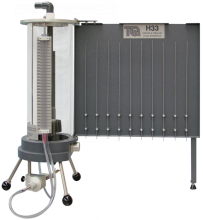 Item Number:H33 - Experiment
An apparatus to allow a full study of the discharge through an orifice or nozzle mounted vertically or the trajectory profiles of an orifice or nozzle mounted horizontally.
-
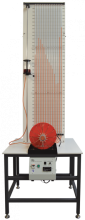 Item Number:TM25 - Experiment
Floor standing apparatus for demonstrating the pressures around a journal bearing at different speeds.
-
 Item Number:AF27 - Experiment
A floor standing apparatus to demonstrate the thermodynamics and fluid mechanics of the adiabatic expansion of air through subsonic and supersonic nozzles.
-
 Item Number:CT5971
The Level system consists of a reservoir water tank, a variable speed pump, a pressure-based level sensor, and clear process vessel with a scale. A proportional valve provides the process vessel drain ..
-
 Item Number:TE3300/04 - Experiment
A self-contained mobile module for level process control experiments to illustrate the principles of single-loop control and the calibration & tuning of controllers, transmitters, converters and valves. Demonstrates feedback control, P/PI/PID control and level control. Cascade control experiments available when used with an optional flow process training system. Distributed control available when used with an optional computer control system.
-

The linear and rotational dynamics kit includes a range of wireless sensors and accessories that allow students and teachers to carry out a range of experiments in dynamics.
-
 Item Number:H311 - Experiment
A self-contained bench mounting apparatus for studies into the settling characteristics of suspended solids and the display of wall effects.
-
 The Locktronics automotive range has been designed to meet the requirements of automotive engineering course standards set by the IMI, City & Guilds, and BTEC. The range is split into three levels, basic, intermediate and advanced and is ideal for automotive technicians to gain a good understanding of electrics, circuits and circuit fault finding, moving through to more complex solutions for an understanding of ECUs and CAN bus in vehicles.
 -
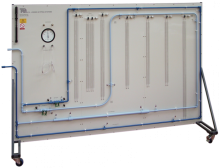 Item Number:H16 - Experiment
An apparatus to allow students to investigate the friction losses in piping systems. The large open format of the apparatus makes it ideal for students working in small or large groups.